Tea 101: Lesson 3 Black Tea for Beginners
Lesson 3 of 4: Rolling and Oxidation — Where Black Tea Flavor Begins
A 5-minute farm-grown tea lesson from Clemson Tea Farm.
In this lesson, we’ll look at how rolling and oxidation help shape the color, aroma, body, and flavor of black tea.
Quick Answer
Why are rolling and oxidation important in black tea?
Rolling bruises the tea leaf and helps release compounds inside the leaf.
Oxidation then changes those compounds, helping create the darker color, fuller body, deeper aroma, and richer flavor associated with black tea.
Together, rolling and oxidation are key steps that shape black tea character.
That is the simple answer.
Now let’s walk through what that looked like during our first Clemson Tea Farm black tea trial.
Welcome Back to Black Tea for Beginners
In Lesson 2, we talked about withering — the quiet step that helps fresh tea leaves soften and lose some moisture.
Now we get to the hands-on part.
Rolling opens the leaf.
Oxidation begins developing black tea character.
This is where the leaf starts acting less like a fresh green leaf and more like black tea.
This is also where things get wonderfully tea-geeky.
At Clemson Tea Farm, this part of the process reminded us that black tea is not made by the clock alone.
It is made by watching.
Smelling.
Touching.
Taking notes.
And trying not to pretend we know more than the leaf.
Why This Matters
Black tea flavor does not just appear.
It develops.
Rolling and oxidation help move the leaf toward the darker color, deeper aroma, fuller body, and richer flavor we expect from black tea.
This is one of the places where tea making becomes both science and observation.
Which is a polite way of saying:
You can read about it all day, but eventually you still have to smell the leaves and make a decision.
What Rolling Does
After withering, the leaf is softer and more flexible.
That matters because the next step is rolling.
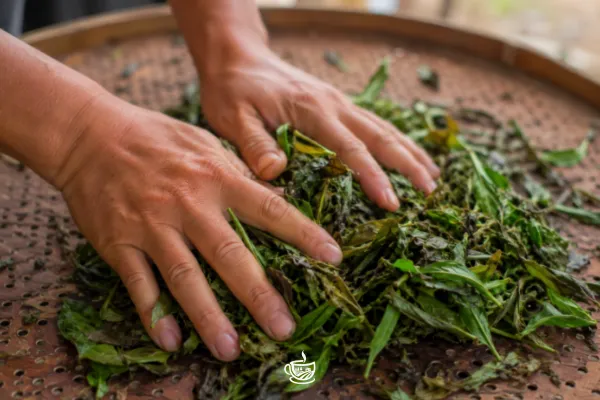
Rolling bruises, twists, and presses the leaf.
That may sound a little rough, but in black tea processing, it is necessary.
Rolling helps open the leaf and release what is inside.
As the leaf is rolled, it may begin to:
Darken slightly
Feel sticky or juicy
Smell less grassy
Clump together more
Look less like fresh-picked leaf
That stickiness is part of the story.
The leaf is beginning to change.
Rolling is not just about shaping the leaf.
It is about helping the inside of the leaf meet oxygen so the next stage can begin.
What Oxidation Does
Oxidation happens after the leaf has been bruised and exposed to oxygen.
This is the big black tea transformation.
During oxidation, the leaf’s color, aroma, and flavor begin moving toward black tea character.
The fresh green smell may soften.
The color may deepen.
The aroma may become warmer, fruitier, maltier, or more tea-like.
This is where black tea begins to show itself.
Not all at once.
Not on command.
But gradually, if we are paying attention.
What Rolling and Oxidation Looked Like in Our First Trial
During our first black tea trial at Clemson Tea Farm, rolling was one of the clearest reminders that small-batch farm processing is very hands-on.
We were working with a small amount of leaf, not a commercial-scale batch.
That meant we had to watch closely:
Was the leaf bruising enough?
Was it clumping?
Was it getting sticky?
Was the aroma changing?
Was it still too green?
Was the color beginning to shift?
Some answers were clear.
Some were more like, “Well, let’s write that down and see what the cup says tomorrow.”
That is the honest part of a trial.
You do not always know everything in the moment.
Sometimes the finished cup tells you what the leaf was trying to say.
Pro Tip
When learning oxidation, use your senses — not just the clock.
Time matters, but oxidation is not only about minutes and hours.
Watch the leaf.
Smell the leaf.
Notice the color.
Feel the texture.
Write down what changes.
A timer can tell you how long it has been.
The leaf tells you what is actually happening.
Nerdy Tangent
Here is your tea geek moment.
Yes, we have said some of this before.
It is worth repeating.
When the rolled leaf is exposed to oxygen, compounds inside the leaf begin to change.
In black tea, catechins are transformed into compounds such as theaflavins and thearubigins.
No need to memorize those for a pop quiz.
But they help explain why black tea looks and tastes different from green tea.
Theaflavins are linked with brightness and briskness.
Thearubigins are linked with deeper color and body.
In plain farm language:
Rolling opens the door.
Oxidation walks through it.
Tiny leaf.
Big chemistry.
Reflection
Rolling and oxidation are teaching us that black tea has to be watched into being.
That may sound dramatic.
But it is true.
Too little oxidation, and the tea may taste grassy or unfinished.
Too much, and the flavor can become flat or dull.
The goal is not simply “make the leaf dark.”
The goal is to help the leaf develop good aroma, color, body, and flavor.
At Clemson Tea Farm, we are still learning how our own leaves move through this stage.
That is the whole point of trial batches.
Each one teaches the next one.
Rolling opens the leaf.
Oxidation develops the black tea character.
This is where black tea flavor begins to take shape.
At Clemson Tea Farm, our first trial batch reminded us that tea processing is not just a recipe.
It is observation, timing, touch, aroma, notes, and a willingness to keep learning.
Step by step, the leaf teaches.
Kinda like life.
Next in Tea 101: Black Tea for Beginners
Lesson 4 of 4: Drying, Tasting, and What We’re Learning About Farm-Grown Black Tea
Next, we’ll finish the tea, taste the cup, and talk honestly about what a trial batch can teach us.
✅ Wanna bring more farm-to-cup wellness into your life?
Sign up to be the first to purchase our Black Tea when available and receive Clemson Tea Farm updates → Get notified
Follow along with Clemson Tea Farm’s Tea 101: Black Tea for Beginners series as we grow, process, taste, and teach farm-grown tea from our fields in South Carolina.
Soil to plant. Plant to harvest. Harvest to brew. Brew to taste. Taste to ritual.
That's the quiet line running through every batch.
Wanna Read More?
Tea 101: Black Tea for Beginners — Lesson 1 of 4: What Makes Black Tea Different?
Tea 101: Black Tea for Beginners — Lesson 2 of 4: Why Withering Matters in Black Tea
Tea 101: Cornerstone Bonus — Why Premium Farm-Grown Tea Takes Time
Wanna Geek Out?
If you want to learn more about rolling, oxidation, and black tea chemistry, these references are helpful:
Tea for Me Please — How Tea is Made: Rolling A helpful explanation of how rolling damages the leaf cells, releases moisture and juices, and helps prepare the leaf for oxidation.
Tea Epicure — Tea Processing Step: Oxidation A clear explanation of oxidation and how it affects tea leaf color, aroma, and flavor.
National Library of Medicine / PMC — Enzymatic Oxidation of Tea Catechins and Its Mechanism A deeper science reference on catechins, enzymes, theaflavins, and thearubigins.
Wanna Keep Learning Black Tea from the Leaf Up?
Follow Clemson Tea Farm’s Tea 101: Black Tea for Beginners series as we continue from fresh leaf to finished cup.
Soil to plant… Plant to harvest… Harvest to wither… Wither to roll… Roll to oxidize…
Step by step, the leaf teaches.
