Tea 101: Lesson 4 Black Tea for Beginners
Lesson 4 of 4: Drying, Tasting, and What We’re Learning About Farm-Grown Black Tea
A 5-minute farm-grown tea lesson from Clemson Tea Farm.
In this final lesson, we’ll look at how black tea is dried, tasted, and used to teach the next batch.
Quick Answer
How is black tea finished after oxidation?
After oxidation, black tea is dried to slow or stop the oxidation process, remove remaining moisture, and preserve the finished leaf. Once dry, the tea is tasted for aroma, color, flavor, body, and finish. Tasting helps guide improvements for future batches.
Welcome Back to Black Tea for Beginners
In the first three lessons, we followed the leaf from fresh harvest through withering, rolling, and oxidation.
Now we come to the finish line.
Or at least what looks like the finish line.
The tea still has to be dried. Then it has to be tasted. Then we have to tell the truth about what the cup is teaching us.
That last part matters.
Why This Matters
Drying and tasting may sound like the simple ending.
Dry the tea.
Brew the tea.
Drink the tea.
Done.
Except, of course, tea rarely lets us get away with that.
Drying affects the final character of the tea. Tasting tells us whether the whole process worked the way we hoped.
This is where a trial batch becomes useful.
Not because it is perfect.
Because it teaches.
What Drying Does
After oxidation, the tea needs to be dried.
Drying helps:
slow or stop oxidation
remove remaining moisture
preserve the finished leaf
prepare the tea for storage
lock in the character developed during processing
The goal is not just “warm the leaves”
The goal is to finish the tea well.
If the tea is not dry enough, it may not store well. If drying is too harsh or poorly timed, the finished cup may lose some of what the leaf developed earlier.
Drying is the closing chapter of processing.
And closing chapters matter.
What Tasting Does
Once the tea is dry and cooled, the real report card begins.
Tasting is not just sipping and saying, “That’s nice.” (Though “that’s nice” is welcome when true.)
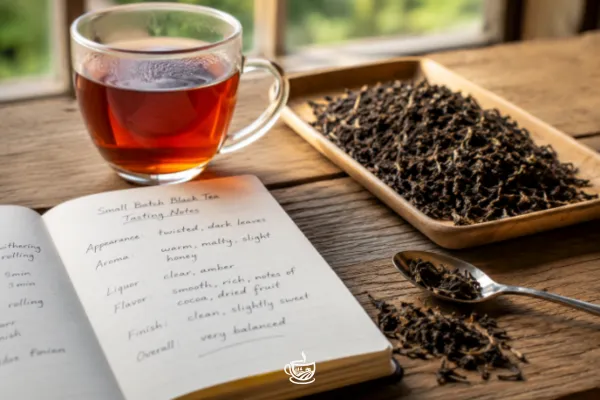
When we taste a trial batch, we look for:
dry leaf appearance
dry leaf aroma
brewed tea color
wet leaf aroma
flavor
body
brightness
astringency
finish
what we would change next time
Tasting helps us connect the finished cup back to the choices we made along the way.
The cup remembers the process.
Here At Clemson Tea Farm
For our first black tea trial at Clemson Tea Farm, the drying step was a learning moment all by itself.
We were working with a small batch, real equipment, real timing, and real questions.
Was the leaf dry enough?
Were there still damp pockets?
Did the aroma hold?
Would the finished tea taste grassy, thin, rich, bright, or something in between?
Those questions matter.
And the only way to answer them honestly is to dry the tea, cool it, brew it, taste it, and take notes.
No pretending.
No dramatic declarations.
Just a cup, a notebook, and the willingness to learn.
Pro Tip
Do not judge a tea trial only while it is hot, wet, or fresh from drying.
Let the finished tea cool completely before storage. Then taste it with a clear process:
smell the dry leaf
brew the tea carefully
notice the cup color
smell the wet leaf
taste slowly
write down what you notice
A trial batch is not just a beverage.
It is feedback.
Nerdy Tangent
Here is the tiny tea geek moment.
Drying slows the chemical changes that were happening during oxidation. It reduces moisture and helps stabilize the finished leaf.
In plain farm language:
Drying tells the leaf, “This is where we stop.”
That means timing matters.
Dry too early, and the tea may not have developed enough.
Dry too late, and the tea may lose some brightness or balance.
The drying step may look like the end.
Really, it is the moment we choose what kind of tea we are keeping.
The Big Picture
This first black tea trial helped us see that tasting is part of processing.
It is not separate.
The cup tells us whether the earlier choices made sense.
Maybe the wither needs adjusting.
Maybe the rolling needs more work.
Maybe oxidation needs more attention.
Maybe drying needs to be steadier.
Maybe the leaf surprised us in a good way.
That is the point.
At Clemson Tea Farm, we are learning how our own leaves behave.
One batch at a time.
What This Series Taught Us
In this 4-part beginner series, we followed black tea from fresh leaf to finished cup.
We learned:
Black tea is not a different plant.
It comes from Camellia sinensis.
Withering prepares the leaf.
The fresh leaf softens and loses moisture.
Rolling and oxidation shape black tea character.
The leaf opens, changes, and begins developing deeper color, aroma, and flavor.
Drying and tasting help us finish and learn.
The tea is preserved, tasted, and used to guide the next batch.
That is black tea for beginners — farm-grown, real-life, and still learning.
A black tea trial is not finished when the leaves are dry. It is finished when the cup has taught us something.
This first series helped us follow the leaf from field to tray to cup.
And it reminded us that premium farm-grown tea is not rushed into being.
It is grown, processed, tasted, adjusted, and learned.
At Clemson Tea Farm, our first black tea trial reminded us that tasting is not the end of the process. It is how the next batch begins.
Read Next
Why Premium Farm-Grown Tea Takes Time
If you followed this Black Tea for Beginners series, you saw how many choices happen between harvest and cup. Next, we’ll step back and look at why premium farm-grown tea takes time — and why that time is part of its value.
✅ Wanna bring more farm-to-cup wellness into your life?
Sign up to be the first to purchase our Black Tea when available and receive Clemson Tea Farm updates → Get notified
Follow along with Clemson Tea Farm’s Tea 101: Black Tea for Beginners series as we grow, process, taste, and teach farm-grown tea from our fields in South Carolina.
Soil to plant. Plant to harvest. Harvest to brew. Brew to taste. Taste to ritual.
That’s the quiet line running through every batch.
Wanna Read More?
Tea 101: Black Tea for Beginners — Lesson 1 of 4: What Makes Black Tea Different?
Tea 101: Black Tea for Beginners — Lesson 2 of 4: Why Withering Matters in Black Tea
Tea 101: Cornerstone Bonus — Why Premium Farm-Grown Tea Takes Time
Wanna Geek Out?
If you want to keep learning about black tea finishing, tasting, and processing, these references are helpful:
University of Hawaiʻi — Home-Processing Black and Green Tea A practical guide to small-scale black and green tea processing.
Tea Epicure — Tea Processing Step: Drying
A helpful explanation of the drying stage in tea processing.
National Library of Medicine / PMC — Enzymatic Oxidation of Tea Catechins and Its Mechanism A deeper science reference on the chemical changes involved in tea oxidation.
