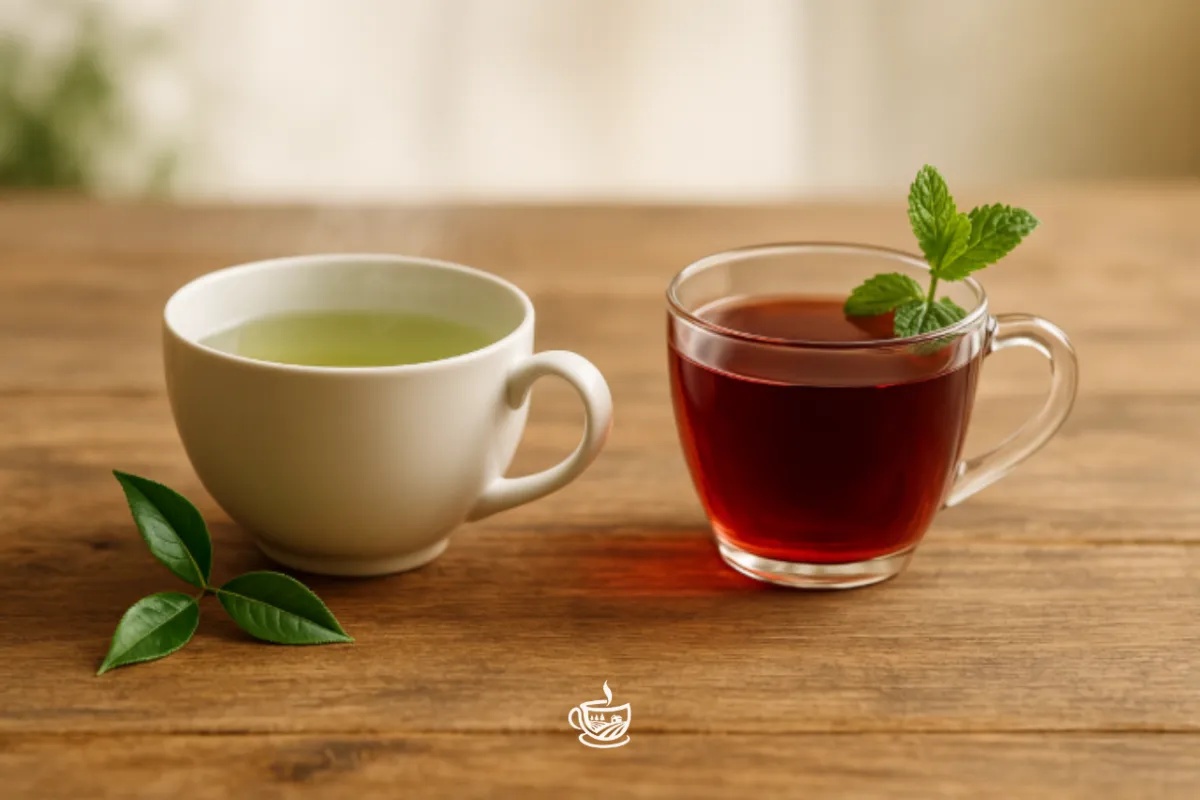
Tea, Tisanes, and That Poor Confused Mug on Your Counter
Learn the real difference between tea and tisanes. Camellia sinensis only, herbs on the side—plus farm examples, health notes, and a printable cheat sheet.
Out here at Clemson Tea Farm, I can hand someone a mug of freshly brewed green tea grown in our south pasture and five minutes later hear,
“Wow, I love this herbal tea!”
Cue my gentle, southern-smile correction: “Friend, that’s not an herb. That’s Camellia sinensis herself.”
In this post, we’re going to clear up the confusion once and for all. Consider this as Camellia sinensis 101.
Plus, there’s a printable Tea vs. Tisanes cheat sheet waiting for you at the end.
What Counts as “Tea”? (Camellia sinensis 101)
If it’s not from the tea plant, it’s not tea. Period.
All true tea—white, green, yellow, oolong, black, and dark/pu-erh—comes from a single evergreen shrub: Camellia sinensis. The different styles are created not by different plants, but by how the leaves and buds are processed after harvest.
At Clemson Tea Farm, that looks like:
Snow Tea ™ from the Winter harvested green tea leaves or the oolong-leaning minimally oxidized batches or as the season warms. the black teas, which are even more oxidized.
All of it…still the same plant
Tea = a beverage* made from the leaves or buds of Camellia sinensis
*Ok, for us tea nerds, the name for the tea liquid is not even “tea” but technically “tea liquor”. And, no, it’s not the alcoholic kind, although hmm, one does “decant” it per se…… ok, now we’re really going down the rabbit hole! So, just for fun let’s repeat together:
Tea = a beverage made from the leaves or buds of the Camellia sinensis plant.
Everything else? Next.
What Is a Tisane? (Herbal Infusions, Not Tea)
A tisane (often pronounced tih-zahn or tee-zahn) is an infusion of herbs, flowers, roots, spices, or fruit—anything except Camellia sinensis. Think:
Peppermint, lemon balm, chamomile
Hibiscus and rose hips
Rooibos and honeybush
Ginger, turmeric, cinnamon, and fruit blends
On the farm, a lot of what we sip in the evenings are tisanes: peppermint, lemon balm, maybe a little fresh ginger (all time fav!). Lovely? Yes. Tea? Nope.
Tisane = an herbal infusion made with plants other than Camellia sinensis.
You can absolutely say “herbal infusion.” I do. I just don’t call it tea around tea nerds haha
Why the Difference Matters (Caffeine, Plant Compounds & Health)
Besides making tea nerds twitch (hi, yes, it’s me again), the distinction matters for many reasons. Here’s three:
1. & 2. Caffeine & Plant Compounds
Tea from Camellia sinensis naturally contains caffeine, plus a whole crew of beneficial compounds like catechins, the aflavins, and L-theanine. Research suggests that tea’s combination of caffeine and L-theanine may support calm alertness, cognitive function, mood, and long-term health when enjoyed regularly as part of an overall healthy lifestyle.
Average ranges (per 6–8 oz cup, brewed normally):
Black tea: ~40–70 mg caffeine
Oolong tea: ~30–40 mg
Green tea: ~20–30 mg (matcha can be higher because you drink the whole leaf)
White tea: often a bit lower, but still caffeinated
Herbal tisanes, on the other hand:
Are usually* caffeine-free, which is why many people love them at bedtime
*A few notable exceptions like yerba mate, guayusa, yaupon holly, and guarana, which naturally contain caffeine even though they aren’t tea
Different plants = different chemistries = different effects in your body.
3. Health Benefits (and Risks)
Tea’s benefits have been fairly well studied:
Green and black tea are linked with cardiovascular support, cognitive benefits, and lower risks of some chronic diseases, likely thanks to their polyphenols and other bioactive compounds.
Herbal tisanes are a different story:
Some herbs are gentle kitchen friends (like peppermint or chamomile)
Others are potent medicinals that can interact with medications or be unsafe in pregnancy or high doses
Multiple reviews on herbal use in pregnancy, for example, raise concerns about limited safety data, variable quality, and the potential for some herbs to be harmful or require caution. Therefore, know what your drinking: Tea or Tissane (words matter).
Pro Tip: “Just because it grows in the herb bed doesn’t mean it’s harmless in your mug. If you’re pregnant, nursing, on medications, or using herbs for specific health issues, check with your doctor and consult reputable herbal safety resources” -Nanelyn Mitchell RN, BSN
Grab Your Tea vs. Tisanes Cheat Sheet
Let’s make this easy the next time you’re half-asleep in front of the kettle.
Download the printable “Tea vs. Tisanes: Camellia sinensis 101” infographic and stick it on your fridge or tea cabinet.
Inside you’ll find:
A simple side-by-side chart of tea vs. tisanes
A mini reminder of when to reach for tea vs. when to reach for a tisane
Curious what Camellia sinensis tastes like straight from the field?
Join our Tea Class & Farm Tour Interest List to taste, pluck, and process tea where it grows.
Wanna Read More?
“What Is Tea, Really? From Leaf to Liquor with Camellia sinensis” (coming soon)
“Caffeine in Tea: Friend or Foe?” (coming soon)
Wanna Geek Out?
For my fellow research-loving sippers:
Overview of herbal infusions and why they’re not tea (but still wonderful in their own right)
Harvard T.H. Chan – The Nutrition Source: “Tea.” Clear plain‑English line that herbal teas are not made from the Camellia plant (and typically lack caffeine).
Royal Botanic Gardens, Kew – “Tea plant (Camellia sinensis).” Authoritative botanic profile for the tea plant.
ISO 3720:2011 — Black tea: definition & basic requirements. The international standard anchoring “tea = Camellia sinensis.”
Michigan State Univ., Center for Research on Ingredient Safety—“Herbal Tea.” Consumer‑friendly explainer on what tisanes are.
Current research on tea’s cognitive, mood, and long-term health effects
Nutrition Reviews (2025): Meta‑analysis—L‑theanine + caffeine linked with benefits for cognition and mood.
Camfield et al., 2014 (systematic review/meta‑analysis): Acute effects of L‑theanine, caffeine, EGCG on cognition/mood (human RCTs).
Jiang et al., 2023 (open access): Tea intake associated with lower dementia risk.
Epidemiology & Health (2024): Meta‑analysis of 38 cohorts—moderate tea consumption tied to lower all‑cause/CVD/cancer mortality.
Wang et al., 2025 (open access): Tea consumption associated with lower all‑cause and CVD outcomes (cohort meta‑analysis).
Harvard Health (2025): Plain‑English summary of what the evidence does—and doesn’t—say.
Some up-to-date reviews on herbal safety in pregnancy and beyond.
NHS—Medicines in pregnancy: Not all “natural” remedies are safe in pregnancy.
NIH Office of Dietary Supplements—Pregnancy (Health Professional Fact Sheet): Nutrient and botanical considerations.
ACOG—Prepregnancy Counseling (Committee Opinion No. 762): Clinicians should review supplements and herbal products.
UK Committee on Toxicity (2020) — “Herbal supplements used in pregnancy” (technical review). Government risk perspective.
BMC Complementary Medicine & Therapies (2016): Multinational safety classification of herbs in pregnancy.
Custom HTML/CSS/JAVASCRIPT
