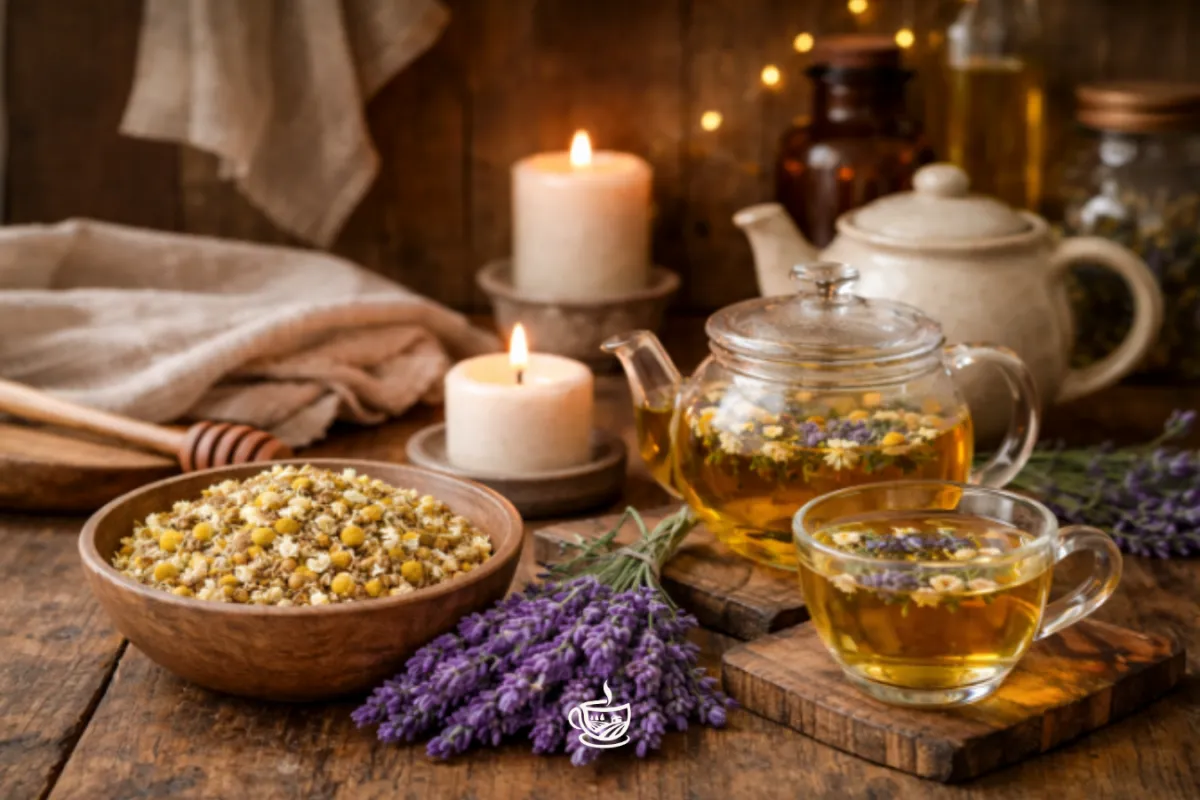
Chamomile vs. Lavender: Which Calms Best?
Chamomile vs. lavender—two calming classics compared for stress, sleep, and daily rituals. Learn which one calms best (and when) from the farm.
Why this matters
If you’ve ever stood in your kitchen at 9:47 p.m., holding a warm mug and thinking, “I need calm, but what kind?”—you’re not alone.
Chamomile and lavender are two of the most beloved calming tisanes (and yes, tisanes—not tea, because tea only comes from Camellia sinensis). They’re often spoken of as interchangeable, but on the body, the brain, and even in the garden, they behave very differently.
Knowing which one to choose—and when— can turn a nice habit into a genuinely supportive ritual.
On the farm, chamomile pops up wherever it feels welcome. Lavender, on the other hand, demands good drainage and respect. Their personalities mirror how they work on us.
What to know first
Chamomile calms from the inside out.
It’s especially helpful when stress shows up as digestive tension, restlessness, or a tight chest.Lavender calms through the senses.
Its aroma works quickly on the nervous system—ideal for anxious thoughts and difficulty falling asleep.Neither is “better.”
They simply serve different kinds of overwhelm.
Chamomile: Gentle, grounding, and gut-wise
Chamomile (Matricaria chamomilla or Chamaemelum nobile) contains apigenin, a flavonoid studied for its mild sedative and anti-anxiety effects. It interacts with receptors in the brain associated with relaxation and sleep—and it does so gently.
Chamomile shines when:
Stress feels heavy in the body
Your stomach is unsettled
You want a calm that doesn’t knock you out
Pro tip:
I let chamomile steep just long enough to soften the day—not so long it turns bitter. Calm should feel kind, not corrective.
Lavender: Aromatic, soothing, and mind-quieting
Lavender (Lavandula angustifolia) works primarily through volatile aromatic compounds like linalool. These interact directly with the limbic system—the emotional center of the brain.
That’s why lavender often works before you’ve even finished the cup.
Lavender shines when:
Thoughts won’t slow down
Anxiety feels floaty or sharp
Sleep trouble starts in the mind
Pro tip:
A little goes a long way. Lavender is powerful—use it as a whisper, not a shout.
Nerdy (but useful) tangent
Smell has a direct neural pathway to the brain. It bypasses logic and memory processing entirely. That’s why lavender can calm you faster than reassurance, while chamomile needs time to work through digestion and circulation.
Different doors. Same destination.
How to choose (and brew)
Step 1: Ask one honest question
Am I tense… or am I spinning?
Tense → Chamomile
Spinning → Lavender
Step 2: Brew with intention
Chamomile: 1–2 tsp dried flowers, steep 5–7 minutes
Lavender: ½–1 tsp buds, steep 3–5 minutes
Step 3: Don’t multitask the moment
Sit. Sip. Breathe. Let the plants do what they do best.
Farm-tested blend:
Mostly chamomile, just a hint of lavender. Grounded body. Quiet mind.
Chamomile steadies the body; lavender quiets the mind—and choosing the right one makes calm feel earned, not accidental.
Wanna Read More?
Tea Is a Plant, Not a Flavor Category
https://blog.clemsonteafarm.com/post/tea-is-a-plant-not-a-flavor-category
Wanna Geek Out?
NIH / MedlinePlus — Chamomile overview
https://medlineplus.gov/druginfo/natural/731.htmlPubMed — Apigenin and anxiolytic effects
https://pubmed.ncbi.nlm.nih.gov/20645849/Frontiers in Behavioral Neuroscience — Lavender and anxiety
https://www.frontiersin.org/articles/10.3389/fnbeh.2017.00043/fullCleveland Clinic — Lavender benefits
https://health.clevelandclinic.org/lavender-benefits/Sleep Foundation — Herbal supports for sleep
https://www.sleepfoundation.org/sleep-aids/herbal-sleep-remedies
