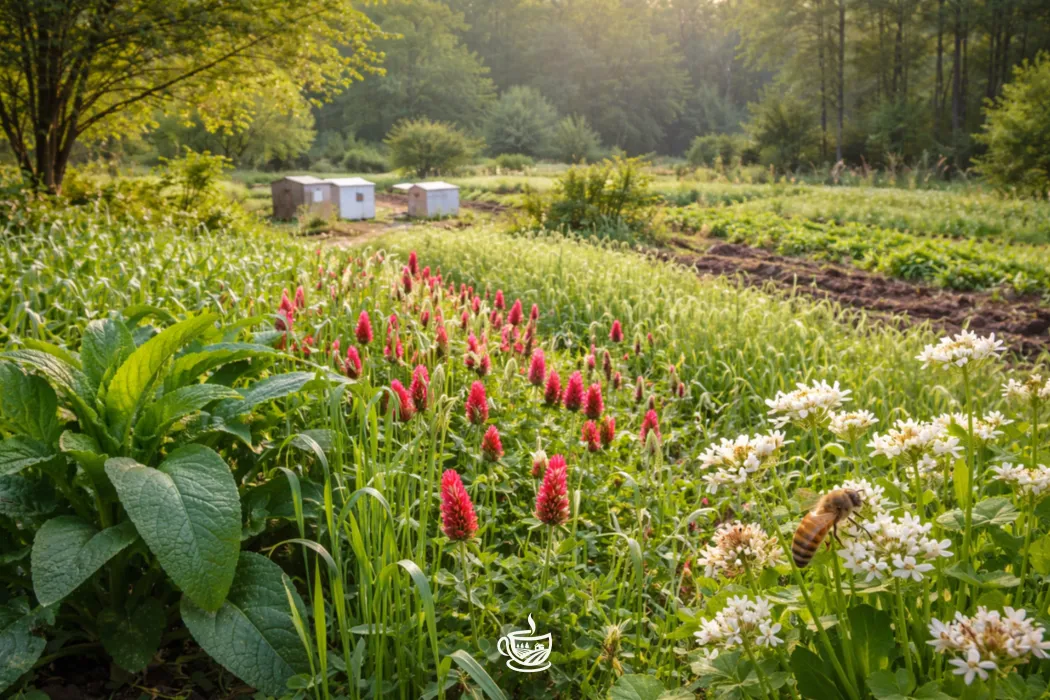
Plant-Based Fertilizers You Can Grow (Without Fertilizing “Right Now”)
Plant-based fertility you can grow—cover crops, comfrey, clover—to protect soil now and feed your garden later (plus bees love it).
Why this matters
Early spring (or any “not-quite-awake-yet” season) is often not the best time to throw fertility at soil—especially nitrogen—because if plants aren’t actively growing, nutrients can move right past the root zone during wet periods. Missouri Extension notes nitrate leaching risk is highest in wet seasons (that's us right now) when crops aren’t actively growing (late fall through early spring). (MU Extension)
Let’s get one thing straight: this is not a pep rally for rushing out and fertilizing today.
Sometimes the smartest move is to pause, cover the soil, and let biology catch up.
Here’s why: when soil is cold and growth is slow, nutrients (especially nitrogen) can be more likely to leach or move away during wet late-winter/early-spring conditions—before plants can use them. (MU Extension)
So why post this now? Because covered soil is resilient soil. Cover crops protect the surface from weather impact and can improve infiltration and soil structure over time.
At Clemson Tea Farm, we cover crop for soil health—and because our bees treat those blooms like an all-you-can-eat brunch.
Quick (but important) disclaimer
This post is informational, not conclusive, and definitely not a substitute for local guidance.
Do your own research for your region and your crops (We are blessed as we have the Clemson Extension Office. Your local cooperative extension office is a great resource)
Use your local Extension office as your “soil translator.”
Soil tests beat guessing every day of the week.
(And yes—my “Wanna Geek Out?” links are a starting point, not a mic-drop.)
What to know first
Think “plant-based fertilizer” as plants that do jobs:
Ground cover + root networks protect soil and boost resilience (less bare dirt drama).
Nutrient scavengers can hold nutrients that might otherwise be lost to runoff/leaching, then return them when terminated. (Purdue University - Extension)
Flowering cover crops can feed pollinators if allowed to bloom (hello, bees). (Purdue University - Extension)
And if you like tidy frameworks: I use a guild-style lens—nitrogen fixers, taproots, dynamic accumulators, groundcovers, beneficial-insect attractors—because it keeps plant choices practical and role-based.
Nerdy tangent: why “wait” is sometimes the best fertilizer plan
If plants aren’t actively growing, they can’t “drink” nutrients efficiently—so nutrients can be wasted (or worse, lost into waterways). Missouri Extension points out that nitrate leaching is most likely during wet periods when the crop is not actively growing, like late fall through early spring. (MU Extension)
Even lawn guidance often echoes the same principle: wait until active growth rather than fertilizing just because the calendar says you can. (Maryland Grows)
How to do it
1) Cover the soil first (because nature hates naked dirt - Regenerative farming principle #1)
Bold move: Choose a cover crop (or mix) that matches your season and goals.
Want soil protection + organic matter? Add a grass like oats or rye.
Want nitrogen support? Add a legume like crimson clover or vetch. (Purdue University - Extension)
Want bee value? Include something that blooms (and manage it wisely). (Purdue University - Extension)
Pro tip: Leave a small patch or strip to flower for pollinators—then terminate before it becomes “free seed distribution.” Cover crops that flower can provide pollen and nectar to pollinators, including bees.
2) Plant a “fertility patch” you can harvest later
Instead of trying to force fertility at the wrong time, grow the ingredients for later:
Nitrogen fixers: clovers, peas, vetch (legumes with root nodules)
Dynamic accumulators/biomass makers: comfrey, nettle (careful, stinging nettle is called, stinging for a reason consider wisely before you use it ), yarrow (great for chop-and-drop mulch)
Taproots: chicory, parsley, daikon-style radishes for soil structure
This is “fertilizer” in the most honest sense: future organic matter + future nutrient cycling, grown on-site.
3) Make it pollinator-friendly (without turning it into chaos)
If bees are part of your farm/garden story (and they should be, just say’n), choose covers that can bloom.
Buckwheat is specifically noted as a flowering cover crop that attracts beneficial insects including bees (plus it’s fast).
Xerces highlights pollinator-friendly cover cropping mixes that can include plants like clovers, buckwheat, and phacelia to support pollinator activity.
Research also shows annual cover crops can provide dense floral resources and attract diverse bees—floral density matters. (ScienceDirect)
Warning Box: “Bee-friendly” doesn’t mean “let everything go to seed.” Manage timing, terminate intentionally, and pick species appropriate for your region.
4) Save the “feeding” for when growth is real
When plants are actively growing and conditions are right, that’s when:
chopped cover crops become mulch,
residue breaks down into organic matter,
and nutrients cycle back into the root zone. (Purdue University - Extension)
That’s the long game. And tea people? We love a long game.
Skip the rush to fertilize. Cover your soil now, grow your fertility plants, and let biology do the heavy lifting—especially if you want healthier land (and happier bees).
Want to bring more farm-to-cup wellness into your life?
We have limited quantities of honey from our bees for local pickup
Wanna Read More?
Garden-to-Cup: Why Soil Shows Up in Your Mug
Tea Tasting 101: The Five Senses (without being fussy)
Wanna Geek Out?
Here are credible starting points—use them to confirm timing/species choices for your region (and remember: no single source is the final word).
USDA NRCS – Cover Crops Overview (erosion control, infiltration, soil structure)
Purdue Extension – Cover Crops in the Home Garden (nutrient scavenging + pollinator nectar/pollen)
Xerces Society – Pollinator-Friendly Cover Cropping (practical mix concepts + on-farm examples)
Cover Crops for Home Gardens (buckwheat attracts bees; crimson clover notes)
Mallinger et al. 2019 (study: annual cover crops can attract diverse bees; floral density matters)
