Our Cover Crop Rotation Plan: Winter Nurture for Tea Land (and Your Nervous System)
Cover crop rotation plan for winter soil health on a tea farm—plus a Nervous System Tea Ritual Infographic for calmer sipping.
Quick link for the busy (hi, same): Download the Nervous System Tea Ritual Infographic
Why winter cover crops matter (even when the farm looks “asleep”)
Winter on a tea farm can look like nothing is happening… which is adorable, because the soil is absolutely not resting. Cover crops are how we “tuck in” our fields so winter rain, wind, and weeds don’t throw a party in bare dirt.
Clemson’s Home & Garden Information Center sums it up well: cover crops help protect soil from erosion, suppress weeds, maintain soil moisture, increase organic matter, and recycle nutrients—but only if you match the species to the job. (Clemson HGIC: Cover Crops for the Fall)
When our tea plants are quiet and storing energy, the alleys between rows still need protection—because “naked soil” is basically an engraved invitation for trouble.
The 3 “jobs” we hire cover crops to do
Think of this like building a farm crew. Everybody gets a role.
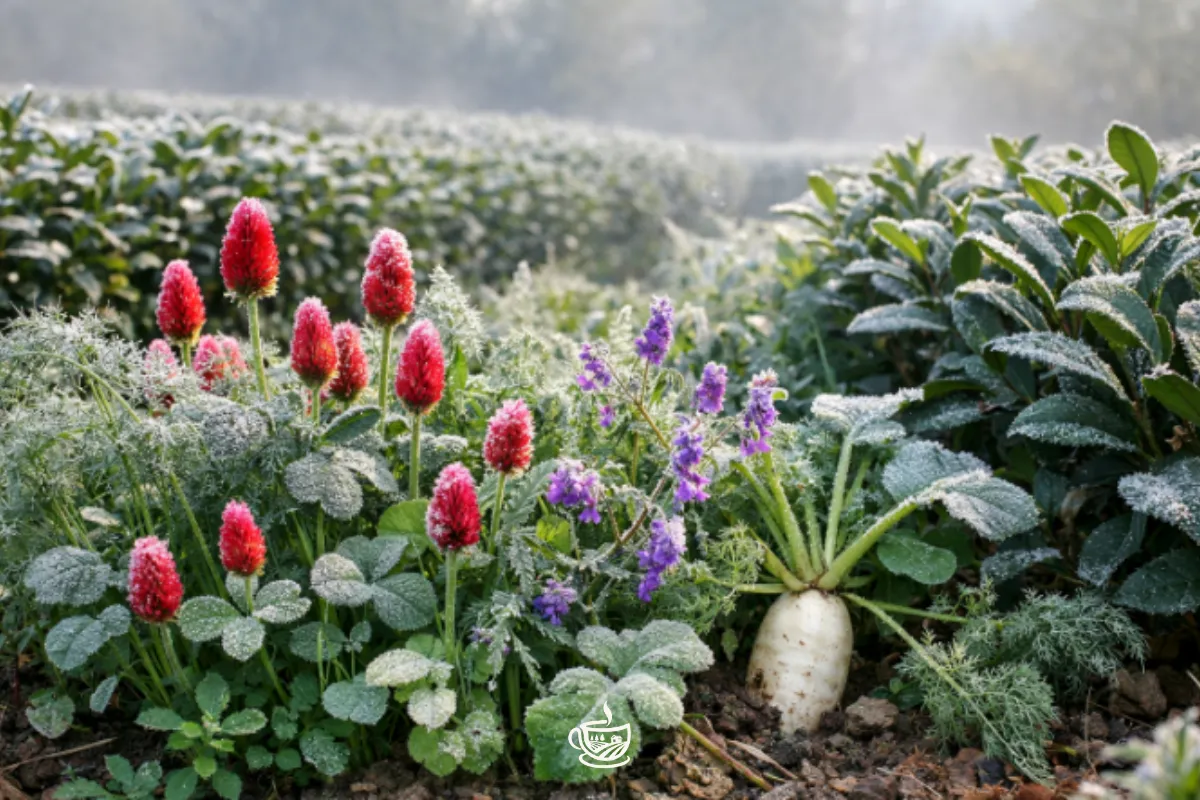
Armor the soil (coverage + biomass): Grasses (like annual rye or oats) are your soil blanket—fast coverage, lots of residue, good nutrient scavenging. (Clemson HGIC: Cover Crops)
Feed the system (nitrogen + biology): Legumes (like crimson clover or winter pea) support fertility and pollinators when managed well. (Clemson HGIC: Cover Crops)
Loosen the “traffic lanes” (structure + infiltration): Deep-rooted options like forage radish can help create channels for water movement and root growth. (USDA also calls out forage radishes as “deep rooted” and helpful for water passages.) (USDA‑NRCS: Soil Health)
Our two‑year cover crop rotation plan (simple, repeatable, and not fussy)
Year A: Winter mix = Grass + Legume + Deep root
Our go-to “tea row alley” blend:
Annual rye + crimson clover + forage radish
Clemson HGIC lists all three as strong cool‑season options (annual rye, crimson clover, forage radish). (Clemson HGIC: Cover Crops for the Fall)
Why we like it:
Rye makes fast cover and residue.
Clover supports nitrogen and spring pollinators (if we let it bloom a bit).
Radish helps with nutrient scavenging and soil structure.
Termination plan (a.k.a. how we keep this from becoming The Cover Crop That Ate the Farm - ask me how I lost a field of tea plants, ugh):
If we’re tilling (which we don’t, but… ) it in: Clemson HGIC recommends terminating and incorporating about 3 weeks to a month before planting so residues can break down. (Clemson HGIC Factsheet: Cover Crops)
If we’re mowing/rolling and leaving residue: Don’t let it set seed. HGIC notes most cover crops should be terminated around 50–80% bloom and before seed if possible. (Clemson HGIC: Cover Crops in Raised Beds)
Pro tip: If you’re new to cover crops, your first win is simply this: cover the soil and terminate on time (We didn't terminate it on time. Ooops. Don’t make our mistake haha). Fancy can come later.
Year A: Warm season follow‑up (optional) = quick cover + beneficial insects
If a space opens up and we want a fast “living mulch moment,” we’ll use a warm-season cover that flowers quickly.
SARE notes that covers allowed to flower can attract and retain beneficial insects—buckwheat and clovers are common examples (timing matters!). (SARE: Cover Crops)
Year B: Winter mix = swap species, keep the functions
Rotate to change root patterns and reduce “same plant, same problems” energy.
Oats + Austrian winter pea (and sometimes a clover)
Clemson HGIC lists oats and Austrian winter pea as cool-season annual options. (Clemson HGIC: Cover Crops)
Why?
Oats can winter‑kill in some conditions (handy when you want easier spring management).
Winter pea is a workhorse legume.
Year B: Warm season follow‑up (optional) = biomass builder
If we’re rebuilding tired soil, we prioritize residue and root activity. USDA‑NRCS emphasizes that cover crops improve soil health by keeping living roots in the ground longer and increasing organic matter over time. (USDA‑NRCS: Soil Health)
Nerdy tangent: cover crop mixes are basically “guilds”… for your soil
A guild is just a plant team: each member supports the others—nitrogen fixers, taproots, groundcovers, pest-confusers, beneficial-insect attractors.
If you want the full guild brain‑candy version, I wrote it up here: What Is a Permaculture Guild? (And Why Your Fruit Tree Will Thank You)
Our tea rows taught me this: monocultures are stressy. Plant communities are steadier—whether it’s the field or your weekly rhythm.
Tea & nervous system: winter nurture isn’t just for land
Let’s be real: winter can make our bodies feel like a shaken snow globe. So we nurture the land and we practice a tiny ritual that tells our nervous system: “You are safe. We are not in a rush.”
My 5‑minute tea ritual (just a very small insight into our 5-day Tea Ritual Reset, sign up):
Breathe: inhale 4, hold 4, exhale 6 (repeat 3 rounds)
Brew: a gentle tisane (think chamomile + lemon balm)
Sip + Sense: smell first, warm hands on the mug, then 3 slow sips
Safety note: Chamomile can cause allergic reactions—especially for folks sensitive to ragweed-family plants—and side effects, though uncommon, can happen. Check trusted guidance if you’re pregnant, nursing, or on meds. (NIH NCCIH: Chamomile—Usefulness and Safety)
Winter cover crops keep our tea land covered, fed, and resilient—so spring growth is joyful, not dramatic.
Printable you can keep by your kettle:
Download the Nervous System Tea Ritual Infographic
