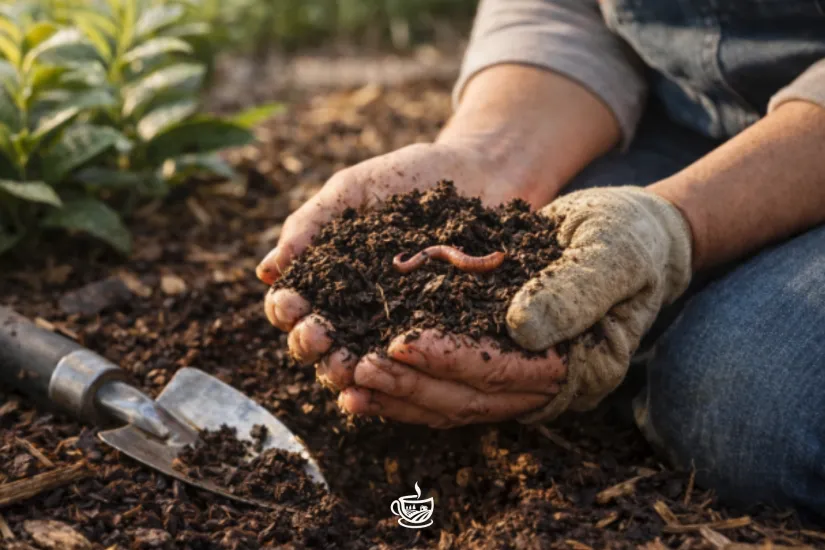
What the Earthworm Population Tells Us (If You Know How to Look)
Earthworms are living soil reports. Learn what their presence—or absence—reveals about soil health, moisture, and fertility in gardens and tea fields.
Why this matters
Earthworms don’t lie.
They don’t respond to trends, labels, or good intentions. They show up—or they don’t—based on conditions. At Clemson Tea Farm, earthworms are one of our most trusted indicators of whether the system is working.
When volunteers dig and suddenly gasp—“There are worms everywhere!”—I know the soil has been quietly doing its job.
What to know first
Worms reflect conditions, not effort. You can’t fake them.
More isn’t always better. Balance matters.
Timing matters. Moist, cool soil gives the clearest read.
What earthworms are telling you
1) Presence = active soil biology
Worms usually indicate:
Adequate organic matter
Stable moisture
Oxygenated structure
They collaborate—feeding microbes, improving aggregation, and cycling nutrients.
2) Type matters
Different worms signal different systems at work:
Surface dwellers → leaf litter and mulch are doing their job
Shallow burrowers → active topsoil and organic inputs
Deep burrowers → long-term structure improving
Seeing variety is a good sign.
3) Absence is information
Few or no worms often point to:
Compaction
Dry soil
Low organic inputs
Excessive disturbance
This isn’t failure—it’s a diagnostic.
Pro tip: Check soil 24–48 hours after rain for the most honest assessment.
How this connects to tea
Tea plants benefit from:
Looser structure
Better drainage
Steadier nutrient availability
Worm activity supports all three—especially important in perennial systems like tea.
Here at Clemson Tea Farm, In our tea rows where worms thrive, leaves tend to grow thicker and more evenly.
What we do to encourage worms (without “adding” them)
Leave organic matter on the surface
Minimize disturbance
Maintain consistent moisture
Keep living roots in the soil year-round
Worms arrive when conditions are right.
What not to do
Don’t add worms to poor soil
Don’t overwork beds “to help”
Don’t panic over seasonal fluctuations
Soil life ebbs and flows.
Nerdy tangent
Earthworm castings contain plant-available nutrients and beneficial microbes—tiny, moving compost factories. Neat, huh?
How to read your soil this week
1. Dig a small test hole.
2. Count worms gently.
3. Notice smell, texture, and moisture.
Observation beats guessing.
Earthworms are soil’s way of saying “yes” or “not yet.” Listen, and they’ll guide your next move.
Want to bring more farm-to-cup wellness into your life?
Download our Soil Life Observation Sheet— a simple, repeatable way to track soil health over time.
Get notified about tea classes
Wanna Read More?
Wanna Geek Out?
USDA NRCS — Soil Biology Primer
https://www.nrcs.usda.gov/resources/education-and-teaching-materials/soil-biology-primer
FAO — Soil Biodiversity
https://www.fao.org/soils-portal/soil-biodiversity/en/
Clemson Extension — Soil Conditioning: Establishing a Successful Gardening Foundation
https://hgic.clemson.edu/factsheet/soil-conditioning-establishing-a-successful-gardening-foundation/
