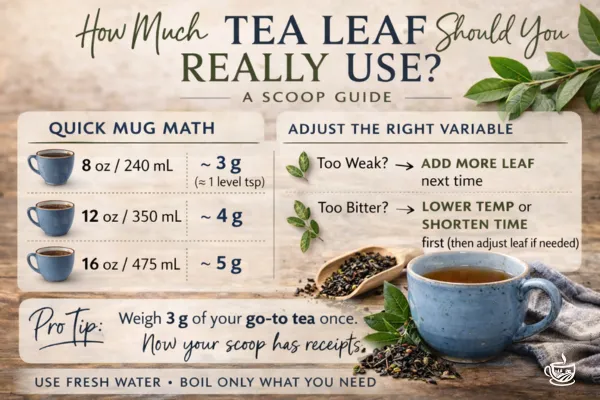
How Much Tea Leaf Should You Really Use? (A Scoop Guide)
How much tea leaf per cup? Use this simple scoop + gram guide to get a better cup fast—plus a free printable brewing ratio card.
Why this matters
If your tea swings wildly between “warm leaf water” and “mouth-puckering regret,” it’s probably not the tea’s fault. It’s the measuring. (And yes, I’m looking at your “heaping spoonful” technique.)
Here’s the truth: your mug is not a “cup.” Most “cups” in tea instructions assume something like 6–8 ounces. Meanwhile, our modern mugs are basically tiny bathtubs. So when you eyeball the leaf and guess the water… you get chaos in a cup.
On spring mornings (or any morning), at Clemson Tea Farm, tasting a fresh cup is part joy, part quality check—and the fastest way to stay consistent is to measure the leaf once, then repeat.
What to know first
Start with a ratio, not a vibe. A dependable beginner baseline is about 1 rounded teaspoon per cup (and then adjust).
Spoons measure volume, but tea strength depends on weight. Fluffy whole leaves can look like a lot but weigh very little; broken leaf can look modest but hit hard.
Temperature matters as much as amount. Black tea likes hotter water (about 90–98°C), green tea cooler (around 80°C).
Nerdy tangent
When you steep tea, you’re extracting compounds that affect flavor and feel (hello, tannins and “why is this bitter?”). Research shows brewing conditions—especially temperature and time—can significantly change what ends up in your cup. Translation: more heat + more time often = more extraction (sometimes great, sometimes “who hurt you?”).
Also: tea tasting professionals use standardized prep methods (so batches can be compared fairly). One well-known standard uses 3 g of tea per 100 mL of water for sensory testing—much stronger than many casual daily cups.
How to do it
1) Pick your baseline (beginner-friendly).
Start with 3 grams of tea per 8 oz (240 mL) of water as your everyday “training wheels” ratio. (No scale yet? Use your scoop—then calibrate once.)
2) Measure your mug once.
Fill your favorite mug with water and pour it into a measuring cup. Write the ounces on the bottom of the mug. Congratulations—you just leveled up your life.
3) Use this quick mug math.
8 oz / 240 mL: ~2-3 g
12 oz / 350 mL: ~3-4 g
16 oz / 475 mL: ~4-5 g
4) Adjust the right variable.
Too weak? Add more leaf next time.
Too bitter? Lower temp or shorten time first (then adjust leaf if needed).
5) Don’t sabotage your water.
Use fresh water and boil only what you need—re-boiling reduces oxygen, which can flatten flavor.
Pro tip: If you’re using a scoop, weigh 3 g of your most common tea one time. Look at what it “fills” in your scoop. Now your scoop has receipts.
Quick warning box
Green tea + boiling water can turn delicate flavors into bitterness fast—cool the water a bit.
More time ≠ is always better. Longer steeps can pull more astringency (and change what extracts).
“A just balance and scales are Divine…” (Wisdom literature: Proverbs 16:11). There’s something grounding about getting the measure right—in the cup, in the garden, and in the daily rhythms when life feels a little too “winging it.”
Measure the mug, start with a simple ratio, and adjust the leaf amount (not chaos), for a better cup every single time.
Want to bring more farm-to-cup wellness into your life?
Download the printable (PDF): Brewing Ratio Card (Beginner)
Get notified for tea classes + volunteer/WWOOF days:
Sign up for notifications for online or in-person classes, volunteer days, or to become a WWOOF-er (so you can learn the “why” behind the cup and get your hands in the real farm work).
Wanna Read More?
Wanna Geek Out?
UK Tea & Infusions Association: “Make a Perfect Brew” (amount + temps)
ISO 3103 sample PDF: standard prep ratios for sensory testing
Peer‑reviewed: Brewing parameters and antioxidant potential (PMC)
