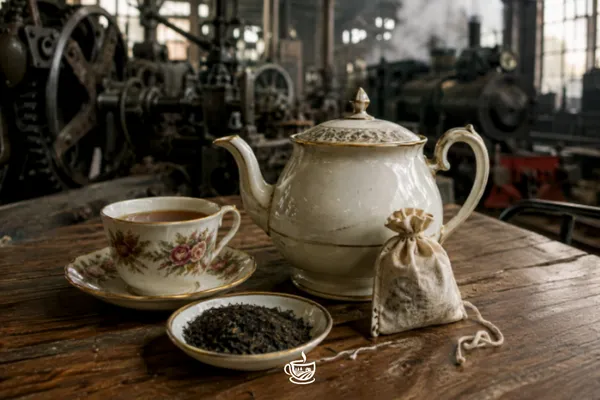
The Industrial Revolution and the Rise of the Teabag
How industrialization made tea cheaper, faster, and easier to package—and prepared the world for the one-cup convenience of the tea bag. - A tea history lesson from Clemson Tea Farm.
Somewhere along the way, tea moved from loose Camellia sinensis leaves measured into a warmed pot to a paper packet dropped into a mug between one task and the next.
The Industrial Revolution did not invent the tea bag. That little packet arrived in the early twentieth century. Industrialization did create the machinery, transportation systems, work schedules, and appetite for convenience that allowed it to flourish.
By then, tea had already shaped trade, empire, and conflict, as we explored in The Opium Wars and the Price of Tea: A History Steeped in Conflict.
How Did the Industrial Revolution Lead to the Tea Bag?
The Industrial Revolution made tea more available and prepared consumers for standardized, convenient products. Mechanized processing, faster transportation, factory schedules, and individual packaging eventually made the tea bag a practical answer to a new question: How can one person brew one cup quickly and consistently?
Tea Became an Everyday Drink
During the eighteenth and nineteenth centuries, tea shifted from an imported luxury toward an everyday drink.
Lower taxes, expanding plantations, steamships, railways, and mechanized packing moved larger amounts of tea more quickly and made it affordable to more households.
There was a harder truth beneath that cheaper cup. Expanding production depended heavily on empire, controlled land, and poorly compensated labor. Industrial efficiency lowered prices for consumers, but it did not make the tea trade fair.
Factory life also reorganized the day around clocks, shifts, and scheduled breaks. Tea fit neatly into that world: warm, caffeinated, affordable, and quick to serve.
Industry had made tea common. The next step was making one serving convenient.
Who Invented the Tea Bag?
Two women deserve to be named first.
In 1901, Roberta C. Lawson and Mary Molaren applied for a patent for a “Tea-Leaf Holder.” Their open-mesh pouch held enough leaves for one serving while allowing hot water to circulate through them. The patent was granted in 1903.
Their design reduced wasted tea and kept loose leaves out of the cup.
A few years later, New York tea merchant Thomas Sullivan helped popularize individually packaged tea. The familiar story says customers steeped his silk sample pouches directly in water and asked for more. Sullivan’s commercial role is well known, although the tidy “accidental invention” story is difficult to prove.
The sounder historical answer is this:
Lawson and Molaren patented an early single-serving tea holder; Sullivan later helped popularize bagged tea.
Machinery Put the Tea Bag in the Cupboard
Early tea pouches were often made from fabric and assembled by hand. Mass production required machines that could portion tea, form porous packets, seal them, and pack them quickly.
By the 1920s, mechanized tea-bag production was expanding. Gauze and silk gradually gave way to filter paper. Manufacturers could offer a standardized amount of tea in a tidy, portable package.
Tea bags became common in the United States before Britain fully embraced them. Tetley introduced tea bags to Britain in 1953, and British use grew sharply during the following decades.
The tea bag offered one measured serving, quick cleanup, easy storage, and no separate strainer. It delivered speed, uniformity, and scale in a remarkably small package.
What Did the Tea Bag Change in the Cup?
Many mass-market bags contain small particles of broken leaf because smaller pieces infuse quickly. More surface area releases color, caffeine, tannins, and flavor faster.
That speed is useful, but it can also produce bitterness and astringency quickly when the water is too hot or the bag is forgotten.
Larger leaves generally need more room and time to open. They may release aroma and flavor more gradually, sometimes across several infusions.
Our Tea 101: Black Tea for Beginners—Lesson 1 of 4: What Makes Black Tea Different? explains how processing shapes Camellia sinensis before it reaches either a bag or an infuser.
Still, a tea bag is a container—not a character reference.
Some bags and larger sachets hold excellent tea. Some loose-leaf tea is ordinary. Look at what is inside and let the cup make its own argument.
Visual Teaching Moment: From Loose Leaf to Tea Bag
1800s: Industrial transportation and packing expanded the tea trade.
1901: Lawson and Molaren apply for their Tea-Leaf Holder patent.
1903: Their patent is granted.
Around 1908: Thomas Sullivan helped popularize bagged tea.
1920s: Mechanical tea-bag production expands.
1953: Tetley introduces tea bags to Britain.
Taste the Difference Yourself
1. Choose comparable teas.
Brew one bagged black tea and one loose-leaf black tea using the same water.
2. Keep the measurements fair.
Use similar leaf-to-water ratios. How Much Tea Leaf Should You Really Use? (A Scoop Guide) gives you a practical starting point.
3. Watch and taste.
Notice the room available to the leaves, how quickly the color develops, and when strength begins turning into bitterness.
Taste both cups plain first. Let the leaf introduce itself before you invite milk, sugar, lemon, and the rest of the neighborhood.
Reflection
The tea bag is easy to blame for rushed, forgettable tea.
That’s too simple.
It made tea practical in workplaces, hospitals, hotels, military settings, and busy homes. It helped millions of people keep tea in their daily lives.
But convenience makes a trade. We gained speed and consistency. Sometimes we surrendered leaf quality, brewing space, sensory attention, and the quiet ritual of preparing a pot.
The better question is not: “Are tea bags bad?”
It is: “What kind of cup do I want today?”
The Industrial Revolution did not invent the tea bag; it created a world ready for standardized, one-cup convenience—and the tea bag arrived prepared to serve it.
Want to Bring More Farm-to-Cup Learning Into Your Life?
Sign up for notifications about tea classes, volunteer days, and WWOOF opportunities through Contact Clemson Tea Farm.
Download the Tea Bag vs Loose Leaf Tasting Sheet here
Wanna Read More?
The Opium Wars and the Price of Tea: A History Steeped in Conflict
Tea 101: Black Tea for Beginners—Lesson 1 of 4: What Makes Black Tea Different?
Wanna Geek Out?
#ClemsonTeaFarm #TeaLeavesAndLifeLessons #TeaHistory #HistoryOfTea #TeaBag #LooseLeafTea #CamelliaSinensis #GardenToCup #DrinkBetterTea
