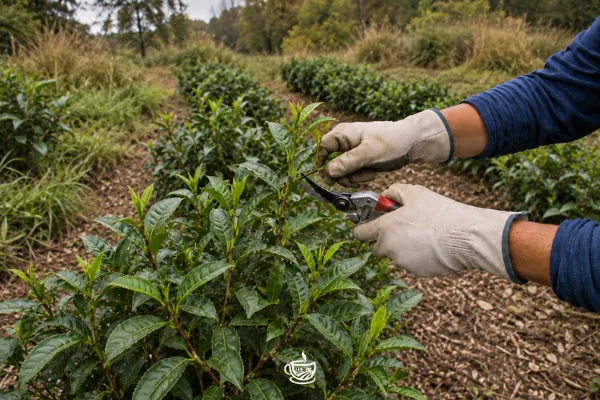
Pruning the Tea Rows for Fall Health
Learn how to prune Camellia sinensis in fall without sacrificing cold hardiness, flowers, or next spring’s tea harvest.
Should You Prune Tea Plants in the Fall?
Quick Answer: Tea plants may receive light, selective pruning in early fall, but fall is not the season for hard reshaping. Remove dead, damaged, diseased, or severely crossing growth, then save major height reduction and plucking-table work for the dormant pruning window before spring growth begins.
By late summer, early Fall, the tea rows can look as tired as the farmer walking them. One branch leans into the path. A vine has arrived without an invitation. One shrub reaches for the sky while its neighbor behaves like it read the handbook.
That does not mean the whole row needs a haircut.
At Clemson Tea Farm, fall pruning begins with observation—not enthusiasm. The patience we use after a late frost applies here: look first, record what you see, and cut only when the plant gives you a reason.
Why Fall Tea-Row Health Matters
Camellia sinensis is evergreen and ours usually flower in fall. It must also prepare its tissues for winter. Hard or late pruning can remove useful canopy and encourage tender regrowth if warm weather lingers, therefore, don’t do that! Think finesse.
Fall maintenance has a narrower purpose:
Improve airflow
Remove genuine problems
Keep paths usable
Reduce hiding places for pests and disease
Prepare notes for the larger winter prune
Tea rows are a crop, not a hedge contest.
How We Prune Tea Rows for Fall Health
1. Walk the row before lifting the pruners.
Look from both sides for dead tips, broken limbs, rubbing branches, vines, growth touching wet soil, unusual spotting, or scale. Photograph questionable areas so you can compare them later.
2. Remove only the obvious troublemakers.
Cut dead, broken, or clearly diseased wood back to healthy tissue. Remove branches that are severely crossing and rubbing. If a branch is merely inconvenient, flag it for winter rather than solving every irritation today.
3. Save structural work for winter.
Do not shear the whole plucking table or reduce the row height in fall. At Clemson Tea Farm, major shaping belongs in our January–February pruning window, when the structure is easier to see and we can prepare the plants for spring growth.
4. Keep tools sharp and clean.
Use bypass pruners that make a clean cut. If disease is suspected, disinfect the blades between affected plants or cuts. Dirty blades can carry trouble down a row like gossip at a church luncheon.
5. Clean beneath the canopy.
Remove diseased leaves, infected twigs, vines, and debris packed against the stems. Restore mulch without piling it against the trunks. Our summer soil-care approach still applies: cover the soil, but let the plant breathe.
Here at Clemson Tea Farm our healthy clippings may be composted or chopped into pathways. Suspected diseased material leaves the tea row rather than becoming next season’s problem.
Think Traffic Signals: Green, Yellow, or Red?
Use this simple field test or our Fall Tea Pruning Field Guide before making a cut.
Green—cut now:
Dead, broken, diseased, or severely rubbing growth.
Yellow—mark and watch:
Low branches, uneven height, crowded interiors, or limbs that may need structural correction.
Red—save for winter:
Hard height reduction, full-row shearing, major limbing-up, or rebuilding the plucking table.
A little flagging tape prevents many “Well, since I’m already holding the pruners…” decisions.
Look Down Before Blaming the Branches
Pruning cannot repair compacted soil, poor drainage, drought stress, or roots buried under mulch.
Check the soil moisture. Pull mulch away from the stems. Note where water stands after rain. Look for earthworms and healthy soil structure.
What the Earthworm Population Tells Us is a useful companion because the canopy often reflects what is happening below it.
Soil → Plant → Harvest → Brew → Taste → Ritual
The pruning cut sits near the beginning of that story.
A Fall Row Is a Planning Map
A clean cut is satisfying, but restraint is also farm work.
Fall shows us where plants grew strongly, where they struggled, which pathways narrowed, and which shrubs will need attention during winter pruning.
We do not need to finish January’s work in October.
We need to leave the row healthier and better understood than we found it.
Fall tea-row pruning is a health check, not a renovation: remove real problems now, protect the living canopy, and save hard shaping for the proper winter window.
Want to Learn Tea by Working Beside It?
Think Traffic Signals and use our Fall Tea Pruning Field Guide before pruning.
Sign up for notifications about tea classes, volunteer days, and WWOOF opportunities at Clemson Tea Farm.
Wanna Read More?
Wanna Geek Out?
#ClemsonTeaFarm #TeaLeavesAndLifeLessons #GardenToCup #CamelliaSinensis #TeaPruning #FallGarden #Zone7b #Zone8a #SoilHealth #RegenerativeFarming
© 2026 Clemson Tea Farm. All rights reserved.
