Tea 101: Black Tea for Beginners
Tea 101: Black Tea for Beginners
Bonus Lesson 6: A Tea Grower’s Morning Walk — What We Check Before Leaving the Farm
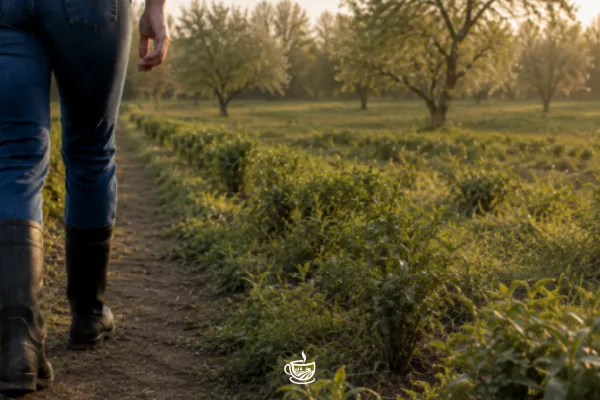
As tea farmers, we walk the rows. This teaches us to read Camellia sinensis before travel: soil, leaves, pests, weather, and timing.
Quick Answer
What does a tea grower check before leaving the farm?
Before leaving Clemson Tea Farm, we check soil moisture, fresh flush, leaf color, pest pressure, mulch, irrigation, weather, and anything that cannot wait. A morning tea farm walk turns the field into a living checklist before the suitcase gets imperious.
That is the simple answer.
Now let’s walk the row.
Why This Matters
At 6:00, before travel, before packing, before the list in my head started multiplying like a Georgia bluetail rabbit (Sylvilagus palustris) in a polite hat, I walk the farm.
Not because everything needed fixing.
Because everything needed noticing.
A tea farm walk is Tea 101 in motion. Before black tea ever reaches withering, rolling, oxidation, drying, brewing, tasting, or ritual, somebody has to walk the rows and read the plant.
If you are new here, start with About Clemson Tea Farm or read Green, Black, Oolong… Same Plant, Different Process. That one explains why black tea is not a different plant. It is a different process.
But the process begins earlier than the tray.
It begins in the field.
At Clemson Tea Farm, a morning walk is how the farm whispers before it has to holler.
What to Know First
Tea plants are woody evergreens. They can look steady while quietly signaling stress.
Roots set the tone. Moist, well-drained, acidic soil supports better growth than soggy or compacted ground.
Travel changes urgency. If you will be gone, check water, heat, pests, young plants, and anything newly planted first.
This is not fancy.
It is faithful.
Tea plants do not need us to hover, but they do need us to observe. Good growers learn the difference between “later” and “today, honey.”
Nerdy Tangent
Camellia sinensis can grow in full sun to partial shade, but young plants and stressed plants often appreciate protection from harsh heat.
The plant may be tough, but tough does not mean ignored.
In our Zone 7b/8a climate, mulch, drainage, airflow, and observation are not decorations. They are farm management.
And yes, this matters for black tea.
A healthier soil gives a flourishing plant which gives us better leaf. Better leaf gives us better harvest. Better harvest gives us better withering, rolling, oxidation, drying, brewing, tasting, and ritual.
Soil to plant.
Plant to harvest.
Harvest to process.
Process to cup.
That line starts under your boots.
How to Do a Tea Farm Walk Before Travel
1. Check the soil
Push a finger into the soil near young plants. Dry at the surface is not always a crisis, but dry below the mulch before travel deserves attention.
2. Read the new flush
Look for tender, light-green growth. New flush tells you the plant is active. It may be nearing harvest, or it may need protection from heat stress.
3. Turn over leaves
Scale and mites do not usually introduce themselves politely. Check the underside of leaves, especially on stressed plants.
4. Look for color changes
Yellowing, bronzing, curling, spotting, and scorched edges are notes from the plant. Do not panic. Just write them down and compare.
5. Check mulch and irrigation
Mulch should protect the soil without smothering the crown. Irrigation should be working before you leave, not discovered broken after you return.
6. Decide what cannot wait
Watering young plants, fixing irrigation, removing diseased material, or shading a tender transplant may matter more than another pair of shoes in the suitcase.
Pro tip: Take the same route each walk. A repeated path trains your eye to notice what changed.
Write it down: Before I leave, I must…(Because the farm loves specificity. And because “I’ll remember” is how irrigation lines, pest pressure, and travel days start conspiring in the corner.)
Reflection
The 6:00 walk is not glamorous content, which is exactly why it is useful.
Farm life is built on quiet repetitions that rarely go viral but often save the crop.
You walk.
You look.
You notice.
You learn what the plant looks like when it is happy, what it looks like when it is thirsty, and what it looks like when it is trying to tell you something before it has to make a scene.
That is tea growing.
And it connects directly to black tea.
The leaf we wither later is shaped by the plant we cared for earlier. The oxidation we watch in the tray begins with the health of the leaf in the field. The cup we serve later is shaped by the walk we took before anyone else knew it mattered.
Soil, plant, harvest, brew, taste, ritual — all of it begins with noticing.
A tea farm walk turns ordinary observation into better plant care, better harvest timing, and eventually a better cup.
Wanna bring more farm-to-cup wellness into your life?
Download the printable Tea Farmer Morning Walk Checklist
Sign up for tea classes, volunteer days, or become a WWOOFer → [Get notified]
Follow along with Clemson Tea Farm’s Tea 101: Black Tea for Beginners series as we grow, process, taste, and teach farm-grown tea from our fields in South Carolina.
Soil to plant. Plant to harvest. Harvest to wither. Wither to roll. Roll to oxidize. Oxidize to dry. Dry to brew. Brew to taste. Taste to ritual.
Step by step, the leaf teaches.
Wanna Read More?
Wanna Geek Out?
NC State Extension — Camellia sinensis Plant Toolbox A practical growing profile with light, soil, drainage, moisture, and hardiness zone details.
American Camellia Society — Growing Camellia sinensis A helpful overview of growing tea plants in Zones 7, 8, and 9 with moist, well-drained acidic soil.
Clemson HGIC — Camellia Diseases and Insect Pests in South Carolina Useful local context for camellia pest and disease monitoring, including tea scale and drainage-related issues.
