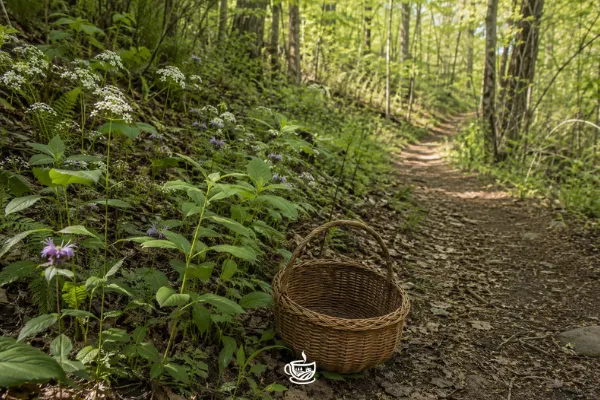
Wild Tea Foraging Laws Under Debate
Wild tea foraging laws vary by location and landowner. Learn what is changing, what South Carolina prohibits, and how to gather plants responsibly.
There is something deeply satisfying about walking through a landscape and recognizing that it contains more than scenery. A fragrant leaf, a ripe berry, or a familiar flower may suggest a cup waiting to be brewed.
But before the basket comes out, we need to settle two matters: vocabulary and permission.
True Tea comes from Camellia sinensis. Most wild leaves and flowers steeped in hot water make tisanes, or an herbal infusion, not what is properly defined as Tea. For a clearer introduction to what makes Tea distinct, visit Black Tea for Beginners: What Makes Black Tea Different.
The second matter is less poetic: public land is not automatically a public pantry.
Is It Legal to Forage Wild Plants for Tea on Public Land?
Quick Answer: Sometimes—but never assume. Foraging law depends on who owns or manages the land, which plant part you take, how much you gather, and whether it is for personal or commercial use. In South Carolina state parks, collecting plants or plant parts is generally prohibited without a permit.
South Carolina State Parks specifically prohibit gathering trees, shrubs, plants, or plant parts without authorization. Their visitor guidance makes the rule even plainer: collecting leaves, roots, berries, mushrooms, and similar natural materials for personal use is not allowed. Research collecting requires a permit.
This article provides general education, not legal advice. Rules can change, so check with the individual land manager before gathering anything
Why Are Foraging Laws Being Debated?
The debate is not simply “foraging is good” versus “foraging is bad.” The harder question is how public agencies can recognize food traditions and personal gathering while still protecting vulnerable plants, wildlife habitat, cultural resources, and heavily visited landscapes.
Different states are answering that question differently.
Oklahoma enacted a law in May 2025 allowing limited personal-consumption gathering of certain nuts, edible plants, and fungi on qualifying state-managed property. The law excludes commercial resale, threatened or endangered plants, certified agricultural crops, and areas where gathering is otherwise restricted.
New Jersey legislators introduced Assembly Bill A3425 in January 2026. The proposal would authorize limited personal-use foraging in state parks and forests while allowing the state to establish restrictions protecting natural resources. It remains a proposal rather than a nationwide model.
Minnesota went further into the discussion by creating a Sustainable Foraging Task Force. Its 2026 report examined existing laws, traditional ecological knowledge, education, permitting, and possible rule changes. A related foraging bill was debated during the 2026 legislative session but was not enacted.
In other words, the legal landscape is moving—but not uniformly.
Public Land, Private Land, and Federal Land Are Different
The phrase public land can describe several entirely different systems.
A city nature preserve may have one rule. A state forest may have another. A state park may prohibit all collecting. A national forest may allow limited gathering under local regulations or permits. A national park normally prohibits plant removal except where a specific regulation, agreement, treaty right, or park-level exception applies.
The National Park Service also has a formal process allowing agreements with federally recognized Tribes for traditional plant gathering in park areas. That is not the same as unrestricted recreational foraging by the general public.
Private property is more straightforward: obtain the landowner’s permission. Preferably, get it in writing and agree on exactly what, where, and how much may be gathered.
How to Forage Without Getting Fined—or being Foolish
1. Identify the land manager.
Determine whether the property is privately owned or managed by a city, county, state agency, national forest, or national park.
2. Read the rule for that specific property.
Do not rely on a general social-media post saying that foraging is “legal in the state.” One park, forest, or preserve may have stricter rules than another.
3. Ask about the plant part and quantity.
A regulation may allow fallen nuts or ripe berries but prohibit digging roots, removing bark, cutting branches, or gathering plants for resale.
4. Obtain permission before harvesting.
A pleasant-looking roadside, vacant lot, trail edge, or woodland patch still belongs to someone.
5. Confirm the plant identification.
Legal does not mean edible. Never consume a plant or mushroom based only on a photograph, phone application, or enthusiastic guess. Poison Control recommends expert identification before eating any wild mushroom.
6. Leave more than you take.
If a population is small, stressed, uncommon, recently sprayed, or heavily visited, leave it alone. Sometimes the responsible harvest is no harvest at all.
At Clemson Tea Farm, harvesting begins with observation. We look at plant health, weather, growth stage, insect activity, and what the plant needs next. Permission may be the legal question, but attention is the stewardship question.
A Simple Visual Teaching Moment: Three Stops Before the Steep
Before gathering a wild plant for a tisane, stop at three checkpoints:
Ownership → Permission → Identification
Miss the first, and you may be trespassing.
Miss the second, and you may be collecting illegally.
Miss the third, and the consequences can be far more serious than a citation.
Only after all three are settled should harvest, drying, brewing, taste, and ritual enter the conversation. Notice we said, “conversation”, not that you should proceed with any harvesting, drying, brewing, tasting etc.
Misidentification of a plant may have deadly consequences. Yikes!
Reflection: A Handful Is Not Always Small
One person taking a handful may appear harmless. Hundreds of visitors taking “just a handful” can strip a trail edge, remove wildlife food, prevent plants from producing seed, and damage the soil around their roots.
Public land belongs to all of us, which means none of us should behave as though every useful plant belongs personally to us.
Good foraging is not measured by how full the basket becomes. It is measured by whether the patch remains healthy after we leave.
Wild plants can connect us to place, but a responsible brew begins before the kettle—with correct plant identification, clear permission, and enough restraint to leave the patch healthier than we found it.
Want to Bring More Farm-to-Cup Knowledge Into Your Life?
Download this helpful guide: Before You Pick: A Public-Land Foraging Permission Checklist
Sign up for notifications about Clemson Tea Farm classes, volunteer opportunities, and WWOOF hosting updates
Check us out - We are WWOOF hosts!
Wanna Read More?
Organic vs. Regenerative: What’s the Difference?
Summer Soil Care: Keep It Covered
Garden Guilds 101: Winter Planning for a Smarter Spring
Wanna Geek Out?
South Carolina State Parks — Rules and Regulations and Frequently Asked Questions.
National Park Service — Gathering of Plants or Plant Parts by Federally Recognized Indian Tribes.
Minnesota Sustainable Foraging Task Force — Final Report and Recommendations.
Oklahoma Senate Bill 447 — Personal-Consumption Foraging on Certain State Property.
#ClemsonTeaFarm #TeaLeavesAndLifeLessons #WildForaging #ForagingLaws #SustainableForaging #PlantIdentification #PublicLands #GardenToCup #CamelliaSinensis #ResponsibleHarvest
© 2026 Clemson Tea Farm. All rights reserved.
