Tea 101 Cornerstone Bonus
Why Premium Farm-Grown Tea Takes Time
Why good tea takes longer than we think—and why that time is part of its value.
A 7-minute, farm-grown tea lesson from Clemson Tea Farm.
In this cornerstone post, we’re stepping back from our Tea 101: Black Tea for Beginners series to look at the bigger picture.
Where does all that time go?
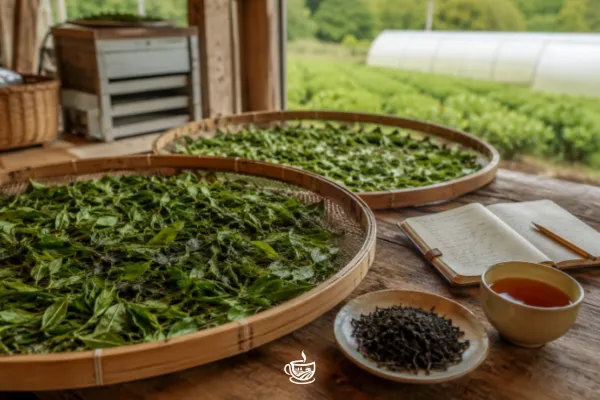
Into the field. The harvest basket. The withering trays. The roller. The tasting table. The notebook.
And, naturally, into a whole lot of leaf listening.
Quick Answer
Why does premium farm-grown tea take time?
Because the finished cup begins taking shape long before hot water meets dry leaf.
It starts with the plant, the soil, the season, the weather, and the timing of the harvest. It continues through withering, rolling, oxidation, drying, tasting, and trying again.
Every batch teaches us something about our plants and how they behave here at Clemson Tea Farm.
The plant matters.
The harvest matters.
The processing matters.
The tasting matters.
The notes definitely matter.
That is the tidy answer.
The less tidy answer? Tea has its own schedule and does not seem especially concerned about ours. haha
Seriously though, let’s walk through it.
From Black Tea Lessons to the Bigger Picture
In our Tea 101: Black Tea for Beginners series, we followed one kind of tea through the process.
We started with the simple truth that black tea is not a different plant. It is a different process.
Then we looked at withering, rolling, oxidation, drying, and tasting.
Step by step, the leaf changed.
Fresh leaves softened. The softened leaves were rolled. The rolled leaves began to oxidize. Then they were dried, brewed, and finally tasted.
That is where the bigger picture comes in.
Tea is grown, harvested, handled, shaped, finished, tasted, and—over time—understood. Then we take what we learned and carry it back to the next harvest basket.
That is the part I love.
Tea gives you one lesson, then another. And just when you think you have the leaf figured out, the weather changes, the season shifts, and the plant smiles politely like: “Well now, let’s see what you do with this.”
Welcome to farm-grown, hand-picked tea.
Why This Matters
Most people meet tea at the cup.
They see the dry leaf, pour the water, and notice the aroma, color, and taste.
That is a beautiful place to meet tea. It is also the last stop in a much loooooonger journey.
The cup began in the field with living plants, changing weather, seasonal timing, careful harvesting, and many small decisions made along the way.
At Clemson Tea Farm, we are learning that no single step gets all the credit.
The sunshine matters.
The rain matters.
The harvest basket matters.
So does the wither, the roll, the oxidation, the drying, and the tasting table.
Every step leaves a fingerprint.
And when the cup is good, you can feel all those little decisions lining up like a choir finally finding the right harmony.
That is where the value lives: not in a fancy story, but in the care and attention behind the cup.
Premium Tea Starts in the Field
Farm-grown tea begins with living Camellia sinensis plants in a real place.
Our place happens to be Clemson Tea Farm in South Carolina.
Here, the field matters. So do the season, the weather, the timing of the harvest, the tenderness of the leaves, and how those leaves are handled after picking.
A young, tender leaf behaves differently from an older, coarser one. A leaf harvested in the cool of the morning may behave differently from one harvested after the day has warmed.
Even leaves from two parts of the same farm may not act exactly alike.
That is not necessarily a problem.
That is the personality of farm-grown tea.
And honestly, that is where things get interesting.
Tea grown on a real farm carries a little of its place and season with it.
Our First Black Tea Trial
Our first black tea trial gave us a very practical reminder:
A good cup is shaped by many small decisions.
We had fresh leaves from Clemson Tea Farm. We had trays, a small roller, drying equipment, and a plan.
We also had the best teacher in the room:
The leaf.
As we worked, we kept asking:
Was the leaf withered enough?
Did the rolling open it well?
Was oxidation building the aroma we wanted?
Was the tea fully dry?
What would the cup tell us the next morning?
Some answers came while we were handling the leaves.
Others had to wait for the tasting cup.
That is the frustrating fun of a trial batch.
You make the tea. You taste it. You take notes. You learn what worked, what surprised you, and what you want to try next.
A trial batch is an argument a conversation with the plant.
And around here, the plant usually has plenty to say.
Pro Tip
Build a repeatable record before you build a pretty story.
For each batch, record:
Harvest date and location
Fresh leaf weight
Weather conditions
Wither time
Rolling method
Oxidation time
Drying temperature
Finished tea weight
Tasting notes
What to repeat
What to change
Good notes may not look glamorous, but they are pure gold on a working farm.
A notebook lets us compare spring with summer, morning harvest with afternoon harvest, a shorter wither with a longer one, and one oxidation window with another.
It also helps us remember what our noses were so certain about yesterday.
Premium tea needs memory.
A notebook gives the farm a memory.
And memory helps the next cup get better.
Small Batches Teach Details
Small batches can be brutally wonderfully honest.
They show us the bright spots, the promising aromas, the beautiful surprises, and the occasional: “Oh, we are absolutely doing that again.”
They also show us where we can improve.
That kind of honesty is useful.
A larger blend can smooth out some differences between batches. A small batch tends to leave more of its season and processing choices showing.
We can follow the leaf more closely from field to cup. We can notice what changed and begin connecting those changes to what we taste.
That clarity helps us understand what our plants may be capable of becoming.
Nerdy Tangent
Here is the tea-geek moment.
Tea quality is shaped by both agriculture and processing.
The finished cup reflects a whole chain of factors: plant health, soil, weather, harvest timing, leaf maturity, withering, rolling, oxidation, drying, storage, and brewing.
Tea is a whole choir of variables.
Sometimes the sopranos are bright and floral.
Sometimes the altos bring body and depth.
Sometimes the tenors wander off toward the compost pile and need a little guidance.
That is farming.
That is tea.
One batch never tells the whole story.
Every harvest adds another verse.
What We’re Learning
At Clemson Tea Farm, we are learning through repetition.
The useful kind:
Try.
Taste.
Take notes.
Adjust.
Try again.
That rhythm builds skill. It teaches us how the plants behave and how different processing choices show up in the finished cup.
Regenerative farming is patient work, but patient does not mean passive.
It means walking the field. Watching the weather. Checking the leaves. Being ready when the plants are ready, even if you had other plans for the day.
It means paying close enough attention to notice what changed.
Right now, we are learning what these plants, in this soil, during this season, can become.
That is where the good stuff lives.
Where the Time Goes
Before harvest, we are watching the plants and the weather.
After harvest, we are handling the leaves, checking the wither, rolling, smelling, watching oxidation, drying, and recording what happened.
Then comes the tasting table.
That is where we find out whether the choices we made gave us the cup we hoped for—or whether the next batch needs a different plan.
None of this needs to be romanticized.
It is simply where the time goes.
And that time does not make every batch perfect. It makes the next batch more informed.
That, to us, is a big part of the value.
Some days it is field-walking work. Some days it is note-taking work. Some days it is cup after cup at the tasting table.
And yes, it is good work.
The kind that makes you grateful for mostly clean boots, sharp senses, and a cup that tells the truth.
Reflection
Farm-grown tea moves through a path:
Soil.
Plant.
Harvest.
Wither.
Roll.
Oxidize.
Dry.
Brew.
Taste.
Learn.
At Clemson Tea Farm, we are still learning how our leaves behave, how each season expresses itself, and how one batch can help shape the next.
That is part of the joy.
Tea carries time inside it.
Time in the soil. Time in the plant. Time in the harvest basket, on the withering tray, in the notebook, and finally in the cup.
And when it all comes together, that time tastes like something worth slowing down for.
Premium farm-grown tea takes time because every cup carries the story of the soil, the plant, the harvest, the processing, the tasting, and the care that shaped it.
✅ Wanna bring more farm-to-cup wellness into your life?
Sign up to be the first to purchase our black tea when available and receive Clemson Tea Farm updates for when we start tours on our farm→ Get notified
At Clemson Tea Farm, every cup follows the larger farm rhythm:
Soil → Plant → Harvest → Process → Brew → Taste → Ritual
Read Next
A Tea Grower’s Morning Walk — What We Check Before Leaving the Farm
Now that we have looked at why premium farm-grown tea takes time, we will head back into the field.
Because before tea is processed, tasted, or named, it has to be observed.
Wanna Read More?
Tea 101: Black Tea for Beginners — Lesson 1 of 4: What Makes Black Tea Different?
Tea 101: Black Tea for Beginners — Lesson 2 of 4: Why Withering Matters in Black Tea
Wanna Geek Out?
Washington State University Extension — Growing Tea in the Pacific Northwest: Tea Types and Home Processing
A U.S.-based Extension guide explaining how processing choices shape tea types from Camellia sinensis.University of Hawaiʻi CTAHR — Home-Processing Black and Green Tea
A practical small-scale guide to black and green tea processing, including withering, rolling, oxidation, and drying.World Green Tea Association — Difference Between Black Tea, Green Tea, and Oolong Tea
A beginner-friendly explanation of how oxidation differences shape green, oolong, and black tea.
